Hexagon highlights connected cabinetry workflows at kbb Birmingham
The kitchens, bedrooms and bathrooms sector is becoming steadily more design led. But for manufacturers, greater design freedom also means greater production complexity.
At kbb Birmingham this year, that tension was visible across the show floor. Richer materials, layered textures, and more personalised cabinetry solutions were everywhere. Yet behind the aesthetics lies a practical challenge: turning increasingly bespoke designs into products that can still be manufactured efficiently and reliably.
That challenge framed much of the discussion on Hexagon’s stand.
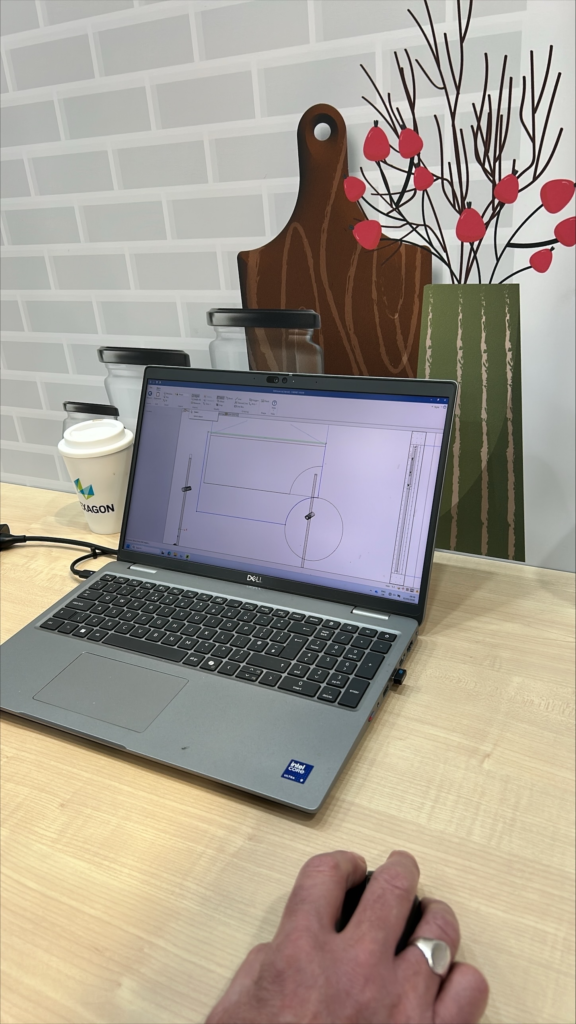
Rather than focusing purely on design presentation, the company demonstrated how digital workflows can help manufacturers move from design configuration to production preparation with greater certainty. Its demonstrations centred on how CABINET VISION and ALPHACAM support a connected process, allowing cabinetry to move from concept through to CNC-ready output while reducing the manual interpretation that can introduce errors or delays.
In today’s KBB environment, customers expect personalised solutions, yet manufacturers still need repeatable processes that allow them to deliver projects profitably. Achieving both requires software that adapts to design variation while maintaining control over how cabinets are actually engineered and produced.
One of the key topics explored on the stand was dimensional automation.
Cabinetry rarely fits neatly into standardised dimensions once it reaches a real project environment. Walls are seldom perfectly square, site conditions vary, and designers frequently adjust cabinet proportions to suit a space. When those changes occur, the underlying product definition must adapt with them.
Hexagon demonstrated how CABINET VISION manages cabinetry parametrically across width, height, and depth, allowing designs to update dynamically while preserving the correct construction logic and manufacturing data.
When cabinet dimensions change, production information such as machining operations, cut lists, and assembly details updates automatically. This reduces the need for manual recalculation and helps ensure the information passed to production reflects the latest design intent. This capability is increasingly important as bespoke and semi-bespoke work continues to grow across the KBB sector.

Many design platforms in the wider market remain centred on catalogue-driven configuration, allowing designers to select predefined products and adapt them within certain limits. While this approach works well for showroom presentation and standard product ranges, it can be restrictive for manufacturers working with their own construction standards and production methods. Hexagon’s approach focuses instead on manufacturer-defined product logic.
With CABINET VISION, manufacturers can create their own cabinet assemblies, define construction methods, and establish rules that reflect how their products are built and machined. In practice, this allows companies to develop bespoke catalogues that mirror their own production standards rather than relying entirely on fixed product libraries.
For businesses producing customised cabinetry, this balance allows design freedom while preserving production discipline.
At kbb Birmingham, Hexagon also demonstrated how accurate site data can strengthen the workflow at the very start of a project.
Using Leica room scanning technology integrated directly with CABINET VISION and VORTEK Spaces, designers can capture precise measurements of a room and use that data to generate immersive visual environments based on the real site conditions.
The aim is not simply visual impact, but confidence. What is scanned reflects the actual space. What is designed within that environment is manufacturable. And what the customer signs off is what ultimately goes into production.
For independent studios and retailers, this approach can make customer conversations clearer and reduce the number of design revisions later in the process. By visualising projects within accurate room environments, designers can set realistic expectations while maintaining control over the production outcome.
Importantly, this capability sits within the same connected workflow. Designs developed in CABINET VISION can flow directly into production preparation, including CNC programming via ALPHACAM, helping ensure the data used on the shop floor reflects the approved design.
Manufacturers face growing expectations for product variety and faster delivery, while skilled labour remains difficult to recruit and retain. Embedding product knowledge into digital workflows allows businesses to preserve expertise and apply it consistently across projects.
Rather than relying solely on individual experience, construction rules and production logic can be captured within the software environment, helping teams move from order confirmation to manufacturing readiness with greater confidence.
Hexagon’s presence at kbb Birmingham reflected that practical reality.
“Design creativity and individuality will continue to drive the KBB sector forward,” said Deon Price,Sales Manager for Wood, Stone & Composites at Hexagon Production Software Division. “But behind every distinctive kitchen or fitted furniture project lies a manufacturing process that must remain controlled, repeatable, and profitable. By connecting accurate site data, intelligent cabinetry design, and production-ready preparation within a single workflow, we can support manufacturers’ deliver their design ambitions without losing control of production.”